Sunday, October 17, 2010
I've Moved Blogs!

Monday, June 07, 2010
Anglo gets another €2bn
Despite the fact that this week the government gave another €2,000,000,000 to Anglo Irish bank (that’s €500 from every man, woman and child in the country) there has been little debate on the subject. It’s almost taken as a given now that every few weeks or so we have to find another lump of money to put into the bank. You have to wonder is this just more good money going after bad. If this was any other business in the private sector it would have been let go to the wall long ago.
Instead of discussing Anglo, the airways have been consumed with the Gazan flotilla and with Ivor Callery’s driving expenses, leaving little room for anything else.
On Wednesday Donie Cassidy arranged for a debate on the subject of Gaza in the Seanad. The Minister of Foreign Affairs was present, as were about 6 or 7 Senators from the different parties. I thought that we had a good debate on the issues, which included discussion about the Goldstone report, Israel’s invitation into the OECD, Operation Cast Lead (from Christmas last year) and of course the attack on the flotilla. Minister Martin was on top of his brief, and I think it was a very useful exploration of the whole issue.
On Thursday we were meant to have the Israeli ambassador come in to our Foreign Affairs Committee. He pulled out at the last minute so instead we had Shane Dillon, one of the travellers from the flotilla, come in to recount his experience. The place was packed with TDs, Senators, journalists and members of the public. It’s not often we get such an attendance at our committee!
On a blog posting a few weeks back I mentioned that I was looking for help over the summer months. There are a few projects I want to get done and we don’t have the capacity in the office to carry them out ourselves. Well, a large number of people applied for the position, I’m glad to say. The calibre of the applicants was excellent and it was difficult to reduce the total number of applicants down to a select set for interview. We held the interviews on Thursday last and we are now making some tough decisions about who to offer the positions to. The reality is that all of the interviewees were very suitable, but the problem is that we haven’t room for everyone!
Many thanks to Cathy in HQ for helping with the arrangements on this.
Instead of discussing Anglo, the airways have been consumed with the Gazan flotilla and with Ivor Callery’s driving expenses, leaving little room for anything else.
On Wednesday Donie Cassidy arranged for a debate on the subject of Gaza in the Seanad. The Minister of Foreign Affairs was present, as were about 6 or 7 Senators from the different parties. I thought that we had a good debate on the issues, which included discussion about the Goldstone report, Israel’s invitation into the OECD, Operation Cast Lead (from Christmas last year) and of course the attack on the flotilla. Minister Martin was on top of his brief, and I think it was a very useful exploration of the whole issue.
On Thursday we were meant to have the Israeli ambassador come in to our Foreign Affairs Committee. He pulled out at the last minute so instead we had Shane Dillon, one of the travellers from the flotilla, come in to recount his experience. The place was packed with TDs, Senators, journalists and members of the public. It’s not often we get such an attendance at our committee!
On a blog posting a few weeks back I mentioned that I was looking for help over the summer months. There are a few projects I want to get done and we don’t have the capacity in the office to carry them out ourselves. Well, a large number of people applied for the position, I’m glad to say. The calibre of the applicants was excellent and it was difficult to reduce the total number of applicants down to a select set for interview. We held the interviews on Thursday last and we are now making some tough decisions about who to offer the positions to. The reality is that all of the interviewees were very suitable, but the problem is that we haven’t room for everyone!
Many thanks to Cathy in HQ for helping with the arrangements on this.
Sunday, May 23, 2010
Canvassing in East Meath
I’ve commented before on the impact that the new Garda communications system TETRA is having on the reception of some people’s TVs in the north east. The problem arises because the TETRA signal interferes with the signals for the BBC, UTV and Channel 4 coming in from Northern Ireland.
We discussed the matter in the Seanad a few weeks back. At the time Minister Conor Lenihan agreed to arrange a meeting with TETRA to see what could be done. We held that meeting on Thursday last in Leinster House.
After our pre-meeting in the Minister’s office we went across to meet TETRA. On the way we managed to get stuck in a lift, and if it wasn’t for the Irish Army we’d probably still be there! I tweeted about it and the matter was subsequently reported in Miriam Lord’s article in Saturday’s Irish Times.
The meeting went well, but the key point for TETRA is that their systems are working as planned, and hence they are not accepting any responsibility for the issue. Us public representatives are most concerned about those people who cannot afford the fix (there’s one available at a cost, including installation, of between €50 and €400, depending on your TV equipment). We’d like to see something done for them.
What was interesting to note however was that the issue of not receiving the BBC and ITV is going to get even more widespread in a couple of years time, when the signal switches from analogue to digital. At that stage every home will need to buy a decoder box if they want to continue getting Northern Ireland programs.
On Friday evening I went along to The Rose Ball in Dublin. It also doubled as Eamon Gimore’s 21st year as a public representative. There was a big crowd there, and it was good to see so many familiar faces. It felt like our annual conference all over again. I was on the water because I had an early start the next morning. I stayed until just after twelve and then drove home.
Saturday was the hottest day of the year. We had canvassing arranged for East Meath so despite the day being more suited to lying on the beach, we carted ourselves from estate to estate. There were lots of people at home, with frequent smells of BBQs from back gardens. Without exception people were in good form, enjoying the balmy weather. Let’s hope it lasts until September. I think we could all do with a respite from the miserable climate we’ve had for the last year. Also, it might have a positive effect on the home tourism market, which we’re all concerned about due to the ash cloud.
We discussed the matter in the Seanad a few weeks back. At the time Minister Conor Lenihan agreed to arrange a meeting with TETRA to see what could be done. We held that meeting on Thursday last in Leinster House.
After our pre-meeting in the Minister’s office we went across to meet TETRA. On the way we managed to get stuck in a lift, and if it wasn’t for the Irish Army we’d probably still be there! I tweeted about it and the matter was subsequently reported in Miriam Lord’s article in Saturday’s Irish Times.
The meeting went well, but the key point for TETRA is that their systems are working as planned, and hence they are not accepting any responsibility for the issue. Us public representatives are most concerned about those people who cannot afford the fix (there’s one available at a cost, including installation, of between €50 and €400, depending on your TV equipment). We’d like to see something done for them.
What was interesting to note however was that the issue of not receiving the BBC and ITV is going to get even more widespread in a couple of years time, when the signal switches from analogue to digital. At that stage every home will need to buy a decoder box if they want to continue getting Northern Ireland programs.
On Friday evening I went along to The Rose Ball in Dublin. It also doubled as Eamon Gimore’s 21st year as a public representative. There was a big crowd there, and it was good to see so many familiar faces. It felt like our annual conference all over again. I was on the water because I had an early start the next morning. I stayed until just after twelve and then drove home.
Saturday was the hottest day of the year. We had canvassing arranged for East Meath so despite the day being more suited to lying on the beach, we carted ourselves from estate to estate. There were lots of people at home, with frequent smells of BBQs from back gardens. Without exception people were in good form, enjoying the balmy weather. Let’s hope it lasts until September. I think we could all do with a respite from the miserable climate we’ve had for the last year. Also, it might have a positive effect on the home tourism market, which we’re all concerned about due to the ash cloud.
Sunday, May 16, 2010
Looking for an Intern....
I was fortunate to attend an opening this week – the new Le Ceile school on the Mill Road in Mornington had its official opening on Friday and I was asked along.
The school has been in the planning stages for many years, so it was great to see the efforts of the parents and teachers finally come to fruition. Over the years I’ve been at meetings, fundraisers and also spoken about the need for the school in the Seanad, so it was great to see the building in place.
The pupils and teachers put on a show for the assembled guests, which was very enjoyable. Around the room I recognised parents from across East Meath – the catchment area for the school would stretch from Drogheda to Bettystown, including areas such as Grange Rath. It’s places like these that have seen significant population growth over the last decade; these permanent school buildings are needed to cater for this growth.
The next campaign in the area will be for a secondary school. I attended a meeting a few weeks back with parents who would like to see an Irish speaking secondary school in the area. Currently there is none in the region. It’s something that needs to be looked at, because we have new Gaelscoileanna starting up in many of our villages and towns in the area and yet once the students are finished primary school they have no options to continue learning through Irish.
During the week I also posted an application looking for someone to come in and work with me for the summer months. They would be working at least 3 days a week throughout July and August. The intern position would suit someone in full-time education who would like to get some research and marketing experience on their cv. The key requirements are for them to be enthusiastic, a team player with a grasp of EXCEL, WORD and the internet. If you know anyone interested that might be suitable then perhaps you could ask them to drop me an email.
The school has been in the planning stages for many years, so it was great to see the efforts of the parents and teachers finally come to fruition. Over the years I’ve been at meetings, fundraisers and also spoken about the need for the school in the Seanad, so it was great to see the building in place.
The pupils and teachers put on a show for the assembled guests, which was very enjoyable. Around the room I recognised parents from across East Meath – the catchment area for the school would stretch from Drogheda to Bettystown, including areas such as Grange Rath. It’s places like these that have seen significant population growth over the last decade; these permanent school buildings are needed to cater for this growth.
The next campaign in the area will be for a secondary school. I attended a meeting a few weeks back with parents who would like to see an Irish speaking secondary school in the area. Currently there is none in the region. It’s something that needs to be looked at, because we have new Gaelscoileanna starting up in many of our villages and towns in the area and yet once the students are finished primary school they have no options to continue learning through Irish.
During the week I also posted an application looking for someone to come in and work with me for the summer months. They would be working at least 3 days a week throughout July and August. The intern position would suit someone in full-time education who would like to get some research and marketing experience on their cv. The key requirements are for them to be enthusiastic, a team player with a grasp of EXCEL, WORD and the internet. If you know anyone interested that might be suitable then perhaps you could ask them to drop me an email.
Sunday, May 09, 2010
Packed out at The Snailbox
On Wednesday I attended a public meeting in The Snailbox Pub at Kilmoon Cross to discuss the Dog Breeding Establishment Bill and the forthcoming Wildlife Bill. The evening was arranged by RISE (Rural Ireland Says Enough) and a crowd of about 350 were present.
Apart from myself and the other local Oireachtas members there were several Councillors present. We listened to the views of speakers from the Ward Union Hunt, a vet, a representative from fishermen and a representative from a Gun Club, amongst others.
The key issue coming out of the meeting was the worry of many that these two pieces of legislation were just the thin edge of the wedge, and that further legislation would come in later, to ban things such as shooting, fishing and even sports such as horse-racing.
I spoke in relation to this. I explained that there is no appetite amongst any politician on our side of the house to ban fishing, or ban shooting. I also updated the audience on the position in relation to the Dog Breeders Bill, including the Labour Party’s tabling of amendments on the inspection regime and on trying to get rid of the dog microchipping proposal. In relation to the Wildlife Bill, the Party has yet to conclude our discussions on the matter and on how we will deal with the government’s proposals.
Despite the strongly-held views of the crowd, it was a pleasant, well-arranged and well-managed meeting. Everyone was very civil to each other, and the evening flew by. I left at about 11:20pm. Rather than eating dinner I went straight to bed, since I had a 6am start on Thursday.
I was already quite beat by the time I got home on Thursday evening, just in time to tune in to the exit polls from the UK. Straight away they were predicting a hung parliament. The Lib Dems spokespeople were all dissing the polls, trotting out the situation of 1992, where the exit polls were way out. I didn’t buy it. Polling has come on considerably since then. A sample of 18,000 people across the country was going to give a fairly accurate prediction of the result, and did, as we subsequently saw.
I was disappointed but not surprised by the result. It was a pity to see Dawn Butler lose her seat. I was glad to see John McDonnell get back in (I did a bit of work on his campaign) and also to see Stephen Twigg get elected after a five year absence. I was particularly pleased to see Yasmin Qureshi become one of the first two Muslim women in the parliament. I worked on Yasmin’s campaign in 2005 when she was narrowly defeated by the Lib Dems. In the north it was great to see Margaret Richie elected in South Down. She had taken time out of her campaign to come to our Galway conference. I was glad to see her absence didn’t impact on her chances.
The next few days and weeks promise to be interesting. For us in Ireland, the key issue is how the new UK government will deal with the economy there – the UK is hugely important to our own economy so we need to watch developments closely.
Apart from myself and the other local Oireachtas members there were several Councillors present. We listened to the views of speakers from the Ward Union Hunt, a vet, a representative from fishermen and a representative from a Gun Club, amongst others.
The key issue coming out of the meeting was the worry of many that these two pieces of legislation were just the thin edge of the wedge, and that further legislation would come in later, to ban things such as shooting, fishing and even sports such as horse-racing.
I spoke in relation to this. I explained that there is no appetite amongst any politician on our side of the house to ban fishing, or ban shooting. I also updated the audience on the position in relation to the Dog Breeders Bill, including the Labour Party’s tabling of amendments on the inspection regime and on trying to get rid of the dog microchipping proposal. In relation to the Wildlife Bill, the Party has yet to conclude our discussions on the matter and on how we will deal with the government’s proposals.
Despite the strongly-held views of the crowd, it was a pleasant, well-arranged and well-managed meeting. Everyone was very civil to each other, and the evening flew by. I left at about 11:20pm. Rather than eating dinner I went straight to bed, since I had a 6am start on Thursday.
I was already quite beat by the time I got home on Thursday evening, just in time to tune in to the exit polls from the UK. Straight away they were predicting a hung parliament. The Lib Dems spokespeople were all dissing the polls, trotting out the situation of 1992, where the exit polls were way out. I didn’t buy it. Polling has come on considerably since then. A sample of 18,000 people across the country was going to give a fairly accurate prediction of the result, and did, as we subsequently saw.
I was disappointed but not surprised by the result. It was a pity to see Dawn Butler lose her seat. I was glad to see John McDonnell get back in (I did a bit of work on his campaign) and also to see Stephen Twigg get elected after a five year absence. I was particularly pleased to see Yasmin Qureshi become one of the first two Muslim women in the parliament. I worked on Yasmin’s campaign in 2005 when she was narrowly defeated by the Lib Dems. In the north it was great to see Margaret Richie elected in South Down. She had taken time out of her campaign to come to our Galway conference. I was glad to see her absence didn’t impact on her chances.
The next few days and weeks promise to be interesting. For us in Ireland, the key issue is how the new UK government will deal with the economy there – the UK is hugely important to our own economy so we need to watch developments closely.
Sunday, May 02, 2010
Access for Pedestrians on M3 Bridges
There was a lot of coverage during the week on the issue of pedestrian links across the new M3 in Dunshaughlin. Basically, there are six new roundabouts linking in to bridges crossing the M3 in the vicinity of Dunshaughlin. It turns out that the designers of the road have two different standards for roundabout design in Ireland depending on whether they are in an urban area or a rural area.
Urban roundabout designs allow for local pedestrians to cross the road. However, rural roundabout assume that there are no pedestrians crossing in the area. On the basis of this assumption roundabouts in rural areas do not come with pedestrian access, such as footpaths and pedestrian crossings.
The problem is of course that in Ireland many people live outside urban areas – In County Meath for instance the urban rural split is probably around 50% / 50%. So, although the M3 is outside the Dunshaughlin urban area, there are still lots of people living alongside it and lots of people who need to get from one side of the M3 to the other.
These people have now formed an action group to protest for footpaths to be added in advance of the M3 opening – scheduled for about 3 months time. On Monday night myself, Cllr Niamh McGowan and others attended a meeting in Dunshaughlin Community Centre organised by the action group.
The group showed a video of how parents and children have to battle their way around the roundabouts – this is before the M3 opens and before traffic levels increase significantly. They also distributed proposals for how the situation could be resolved – putting in new footpaths around the roundabouts.
I spoke from the floor to the meeting, as did others, paying tribute to the work the group has done to date and offering support to get the situation resolved. They are impressive as a lobbying force. Later that week they got the front page of the Daily Mail and the Pat Kenny Show also covered it. We’re all hopeful that a sensible and safe resolution can be achieved in the near future.
At the weekend I attended the Ashbourne Fare Day on Killegland Street. It was organised by the Chamber of Commerce and the intention was to attract as many people into the street as possible. Most of the businesses in the area put up stalls on the closed-off street.
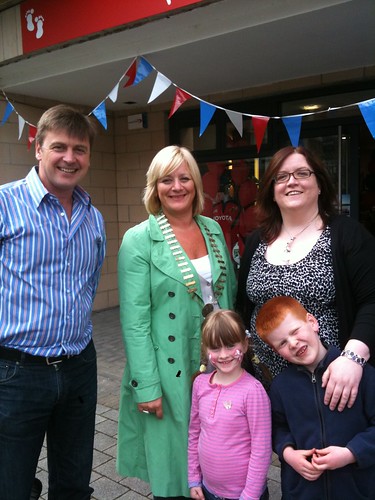
Dominic, Aine Lee of the Chamber and Cllr Niamh McGowan with Catherine and Charlie
It was great to see so many residents out on the streets. The weather wasn’t great – a lot of rain early on. But it did brighten up in the afternoon and I think everyone had some fun.
Urban roundabout designs allow for local pedestrians to cross the road. However, rural roundabout assume that there are no pedestrians crossing in the area. On the basis of this assumption roundabouts in rural areas do not come with pedestrian access, such as footpaths and pedestrian crossings.
The problem is of course that in Ireland many people live outside urban areas – In County Meath for instance the urban rural split is probably around 50% / 50%. So, although the M3 is outside the Dunshaughlin urban area, there are still lots of people living alongside it and lots of people who need to get from one side of the M3 to the other.
These people have now formed an action group to protest for footpaths to be added in advance of the M3 opening – scheduled for about 3 months time. On Monday night myself, Cllr Niamh McGowan and others attended a meeting in Dunshaughlin Community Centre organised by the action group.
The group showed a video of how parents and children have to battle their way around the roundabouts – this is before the M3 opens and before traffic levels increase significantly. They also distributed proposals for how the situation could be resolved – putting in new footpaths around the roundabouts.
I spoke from the floor to the meeting, as did others, paying tribute to the work the group has done to date and offering support to get the situation resolved. They are impressive as a lobbying force. Later that week they got the front page of the Daily Mail and the Pat Kenny Show also covered it. We’re all hopeful that a sensible and safe resolution can be achieved in the near future.
At the weekend I attended the Ashbourne Fare Day on Killegland Street. It was organised by the Chamber of Commerce and the intention was to attract as many people into the street as possible. Most of the businesses in the area put up stalls on the closed-off street.
Dominic, Aine Lee of the Chamber and Cllr Niamh McGowan with Catherine and Charlie
It was great to see so many residents out on the streets. The weather wasn’t great – a lot of rain early on. But it did brighten up in the afternoon and I think everyone had some fun.
Sunday, April 11, 2010
Councillors Conference in Sligo – Who pays for work in Unfinished Estates?
Senators are elected by local county and city councillors. The “trades association” of these councillors is known as LAMA (the Local Authorities Members Association). It’s a very important body for Senators, since they have the clout and influence to determine many elections to the Seanad.
LAMA holds conferences for its members every six months or so. I was invited to attend and speak at this Saturday’s one in Sligo by a member of the LAMA executive, Labour Councillor Pat Hayes from Waterford. Pat gave me a free rein to talk about whatever subject I thought would be of interest to the Councillors.
I know from my emails and telephone calls that currently one of the biggest issues in relation to councillors is the proposed new Planning & Development Bill, and how that impacts on local councils, councillors and their constituents. So, I decided to focus my contribution on this Bill.
I got on the road at twenty past seven and motored along serene and empty roads all the up through up the M1 from Drogheda, through Monaghan and across via Eniskillen to Sligo. I arrived in time to hear local Senator Mark McSharry finish his contribution and then listened to the comments of Kerry-based Senator Paul Coughlan. Both of these also addressed issues in relation to the Planning & Development Bill.
Whilst most people welcome the new bill in principle, there are some issues that are of concern. I focused on some in particular, including the need to carry out a comprehensive assessment of the costs of completing unfinished estates.
The Bill has new powers in relation to finishing estates and allowing local residents to push for them to be taken in charge. The question arises though, if a developer cannot finish the works in an estate (say they go bust, an increasingly frequent phenomenon) then how are the completion works paid for?
This eventuality was meant to be covered by forcing developers to put a bond in place with a bank. Some councils are cagey as to what exactly this entails, but from what I can ascertain often this meant the developer purchased some sort of insurance for X euros from the bank, which guaranteed to pay out 100x euros or 500x euros if the bond was ever called in. It did NOT mean that the developer lodged a cash sum equal to the bond required into the bank.
Roll on a few years, to 2010. The recession is biting and many developers are going to the wall. Picture an unfinished estates first occupied in the middle of the decade in 2005. Residents are sitting in their reasonably new homes, built five years ago, now in negative equity, and they want their estate finished off. They petition the local authority to finish the estate.
In Meath alone there are probably a hundred estates waiting to be taken in charge. If say a third of them require further works then that could amount to 30 estates in Meath alone. Gross that up nationally and we could be talking about 500 estates requiring completion works. If each taking in charge costs say €200,000 then this would be a requirement of possibly €100 million. The bank bonds are meant to cover these costs.
This is not a huge amount of money, but if no allowance has been made within the coffers of the banks then it makes it less likely for these completion works to be carried out.
So, I’m going to table a question to Minister Lenihan, asking him can he give information on the amount of completion bonds still outstanding which are held by the main Irish Banks. I don’t expect to get too far with the question, but at least it might concentrate a few minds on this issue.
LAMA holds conferences for its members every six months or so. I was invited to attend and speak at this Saturday’s one in Sligo by a member of the LAMA executive, Labour Councillor Pat Hayes from Waterford. Pat gave me a free rein to talk about whatever subject I thought would be of interest to the Councillors.
I know from my emails and telephone calls that currently one of the biggest issues in relation to councillors is the proposed new Planning & Development Bill, and how that impacts on local councils, councillors and their constituents. So, I decided to focus my contribution on this Bill.
I got on the road at twenty past seven and motored along serene and empty roads all the up through up the M1 from Drogheda, through Monaghan and across via Eniskillen to Sligo. I arrived in time to hear local Senator Mark McSharry finish his contribution and then listened to the comments of Kerry-based Senator Paul Coughlan. Both of these also addressed issues in relation to the Planning & Development Bill.
Whilst most people welcome the new bill in principle, there are some issues that are of concern. I focused on some in particular, including the need to carry out a comprehensive assessment of the costs of completing unfinished estates.
The Bill has new powers in relation to finishing estates and allowing local residents to push for them to be taken in charge. The question arises though, if a developer cannot finish the works in an estate (say they go bust, an increasingly frequent phenomenon) then how are the completion works paid for?
This eventuality was meant to be covered by forcing developers to put a bond in place with a bank. Some councils are cagey as to what exactly this entails, but from what I can ascertain often this meant the developer purchased some sort of insurance for X euros from the bank, which guaranteed to pay out 100x euros or 500x euros if the bond was ever called in. It did NOT mean that the developer lodged a cash sum equal to the bond required into the bank.
Roll on a few years, to 2010. The recession is biting and many developers are going to the wall. Picture an unfinished estates first occupied in the middle of the decade in 2005. Residents are sitting in their reasonably new homes, built five years ago, now in negative equity, and they want their estate finished off. They petition the local authority to finish the estate.
In Meath alone there are probably a hundred estates waiting to be taken in charge. If say a third of them require further works then that could amount to 30 estates in Meath alone. Gross that up nationally and we could be talking about 500 estates requiring completion works. If each taking in charge costs say €200,000 then this would be a requirement of possibly €100 million. The bank bonds are meant to cover these costs.
This is not a huge amount of money, but if no allowance has been made within the coffers of the banks then it makes it less likely for these completion works to be carried out.
So, I’m going to table a question to Minister Lenihan, asking him can he give information on the amount of completion bonds still outstanding which are held by the main Irish Banks. I don’t expect to get too far with the question, but at least it might concentrate a few minds on this issue.